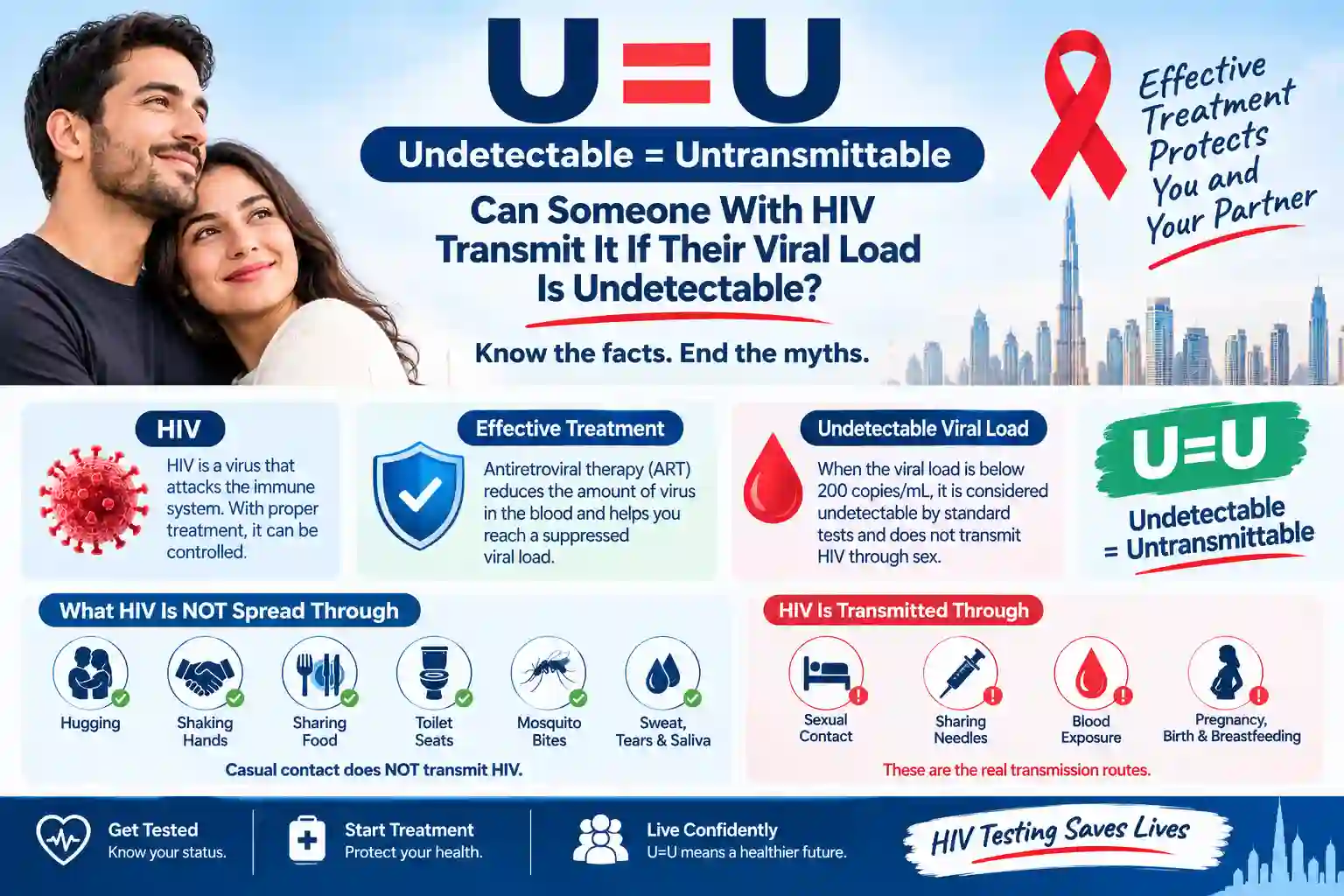
One of the most important advances in HIV treatment is the scientific principle known as U=U, which stands for Undetectable = Untransmittable.
But what does it actually mean? Can a person living with HIV have a relationship, get married, and have sex without transmitting HIV to their partner?
The answer is yes, when the person is taking effective HIV treatment and has achieved and maintained the required viral suppression.
For people in Dubai, Abu Dhabi, Sharjah, and across the UAE, understanding U=U can help replace outdated fears with accurate medical information. This guide explains how an undetectable viral load works, what treatment involves, and what U=U does and does not mean.
1. What does U=U mean?
U=U means Undetectable = Untransmittable.
It describes the fact that a person living with HIV who takes antiretroviral therapy (ART) and maintains a suppressed viral load below 200 copies/mL does not sexually transmit HIV to their partners.
HIV treatment reduces the amount of virus in the blood. When treatment works effectively, the viral load can become so low that standard laboratory viral load tests cannot detect it.
This does not mean HIV has disappeared from the body. It means the amount of virus is controlled to a level at which sexual transmission does not occur.
The CDC, WHO, and other leading health authorities recognise the evidence supporting U=U.
2. What is an undetectable HIV viral load?
A viral load test measures the amount of HIV RNA in a person's blood. The result is generally reported as copies of HIV per millilitre of blood.
A healthcare professional may describe a viral load as:
High or detectable: The test measures a higher amount of HIV in the blood.
Suppressed: Treatment has reduced the viral load substantially.
Undetectable: The amount of HIV is below the detection limit of the particular laboratory test.
For U=U, the key clinical threshold used in major treatment guidance is a viral load below 200 copies/mL.
Different laboratories use different assays, so the exact numerical meaning of “undetectable” can vary. A clinician interprets the result using the test's reporting range and the person's treatment history.
3. How does HIV treatment make the viral load undetectable?
HIV is treated using antiretroviral therapy, commonly called ART.
ART uses medicines that stop HIV from reproducing efficiently. When taken consistently as prescribed, treatment can reduce the amount of virus in the body and protect the immune system.
A typical treatment journey involves:
HIV diagnosis: Appropriate testing confirms the diagnosis.
Starting treatment: A healthcare professional selects an appropriate ART regimen.
Monitoring: Blood tests measure viral load and assess treatment response.
Viral suppression: The amount of HIV decreases as treatment works.
Maintaining suppression: Continued treatment and regular monitoring help keep the viral load suppressed.
Many people taking effective treatment reach an undetectable viral load within approximately six months, although the timing varies.
ART is not a cure for HIV. Treatment must continue as prescribed, and medical follow-up remains important.
4. Can someone with an undetectable viral load transmit HIV through sex?
No. A person who maintains a viral load below 200 copies/mL through effective HIV treatment does not sexually transmit HIV.
This applies to sexual transmission through vaginal and anal sex. The U=U evidence is supported by large studies involving couples where one partner was living with HIV and the other was HIV-negative.
This is an important message for couples:
A person living with HIV can have a healthy relationship.
An HIV-negative partner does not acquire HIV through sex when U=U conditions are maintained.
HIV treatment benefits both the health of the person taking it and sexual HIV prevention.
HIV status does not prevent someone from building a loving relationship or planning a future.
U=U is based on sustained viral suppression, not simply having taken HIV medication once or receiving a single undetectable result.
5. Does undetectable mean HIV is completely cured?
No. An undetectable viral load does not mean HIV has been eliminated from the body.
HIV can remain in certain cells and tissues even when the amount of virus in the blood is too low to be detected by standard tests.
This is why people living with HIV need to continue their treatment even when their viral load is undetectable.
Stopping medication without medical advice can allow the virus to increase again.
The distinction is important:
| Undetectable HIV | HIV cure |
|---|---|
| Viral load is below the test's detection limit or within the relevant suppression threshold | HIV has been eliminated or permanently controlled without ongoing treatment |
| Achieved through effective ART | Not currently available as routine treatment |
| Requires continued medication and monitoring | Would mean no ongoing HIV treatment is needed |
| Prevents sexual HIV transmission when suppression is maintained | A different medical outcome |
6. What happens if someone stops taking HIV medication?
Consistent treatment is essential for maintaining viral suppression.
If someone stops taking ART or regularly misses doses, the viral load may increase. This is sometimes called viral rebound.
If the viral load rises to 200 copies/mL or above, the person should not assume that U=U protection still applies. Their healthcare professional can assess the result, review treatment, and advise on additional prevention measures until suppression is confirmed again.
People experiencing difficulties with medication should speak with their HIV care team rather than stopping treatment independently.
7. Does U=U prevent other sexually transmitted infections?
No. U=U specifically relates to the sexual transmission of HIV.
It does not prevent other sexually transmitted infections, including:
Syphilis
Gonorrhoea
Chlamydia
Herpes
Human papillomavirus (HPV)
Hepatitis B
Condoms, appropriate vaccination, STI screening, and professional sexual-health advice can help reduce other risks.
If you have symptoms or a possible STI exposure, speak with a healthcare professional about appropriate testing.
8. Does U=U apply to pregnancy and breastfeeding?
HIV treatment greatly reduces the risk of transmission from a pregnant person to their baby. However, pregnancy, childbirth, and breastfeeding require specific medical guidance and monitoring.
The sexual-transmission evidence behind U=U should not be used as a substitute for specialist advice about transmission during pregnancy, delivery, or breastfeeding.
People living with HIV who are planning a pregnancy or are already pregnant should consult an HIV specialist and maternity-care team. Effective treatment and appropriate care can make it possible to have a healthy pregnancy while substantially reducing the risk of transmission to the baby.
9. Can an HIV home test show whether someone is undetectable?
No. A standard HIV self-test cannot determine whether a person living with HIV has an undetectable viral load.
There are two different types of testing:
HIV screening tests: These detect markers of HIV infection, such as antibodies or antigen and antibodies. They are used to screen for HIV.
HIV viral load tests: These measure the amount of HIV RNA in the blood. They are used by healthcare professionals to monitor treatment response and viral suppression.
If someone has HIV and wants to know whether they have reached an undetectable viral load, they need the appropriate laboratory viral load test through their healthcare provider.
If you are looking for an initial HIV screening option, explore the SureTestKit HIV test kit collection.
You can also review:
Always check the individual product's intended use, sample type, and detection window. A screening kit is not a substitute for a laboratory viral load test or confirmatory diagnosis.
10. What if you are worried about a recent HIV exposure?
U=U is reassuring when a partner's sustained viral suppression is established and maintained.
However, if you do not know a partner's current viral load status, or you are concerned about another possible exposure, seek appropriate medical advice.
If a possible exposure occurred within the last 72 hours, seek urgent medical assessment to determine whether post-exposure prophylaxis (PEP) is appropriate. PEP should be started as soon as possible when indicated.
Do not delay medical care while waiting for a home test result.
Frequently Asked Questions
Can someone with an undetectable viral load transmit HIV through unprotected sex?
When a person maintains a viral load below 200 copies/mL through effective treatment, they do not sexually transmit HIV. This is the principle of U=U.
How long does it take to become undetectable after starting HIV treatment?
Many people reach an undetectable viral load within approximately six months, but the timeline varies. Regular viral load testing confirms the response to treatment.
Does an undetectable viral load mean HIV is gone?
No. HIV remains in the body, but treatment controls it. ART must continue as prescribed.
Can an HIV self-test confirm an undetectable viral load?
No. An HIV self-test screens for HIV infection. A laboratory viral load test is needed to measure the amount of HIV in the blood.
Does U=U protect against syphilis or gonorrhoea?
No. U=U prevents sexual HIV transmission when viral suppression is maintained. It does not prevent other STIs.
Can someone living with HIV get married and have children?
Yes. People living with HIV can have relationships and plan families. Effective treatment and specialist medical care can help protect partners and reduce the risk of transmission to a baby.
Conclusion
U=U is one of the most significant developments in modern HIV care. It means that a person living with HIV who maintains a viral load below 200 copies/mL through effective treatment does not sexually transmit HIV.
This scientific evidence helps people make informed decisions, build relationships, and challenge the stigma that still surrounds HIV.
Remember that undetectable does not mean cured. Continuing treatment and regular viral load monitoring are essential.
If you are in Dubai, Abu Dhabi, Sharjah, or anywhere across the UAE, understanding HIV testing and screening can help you make informed decisions about your health.
Know the facts. Understand your status. Support informed HIV awareness.
Explore HIV screening options at SureTestKit UAE.
This article is for educational purposes only. It does not replace professional medical advice, diagnosis, or treatment.
Disclaimer
This content is intended for informational purposes only and should not be considered a substitute for professional advice. Always consult with a qualified professional for specific concerns.