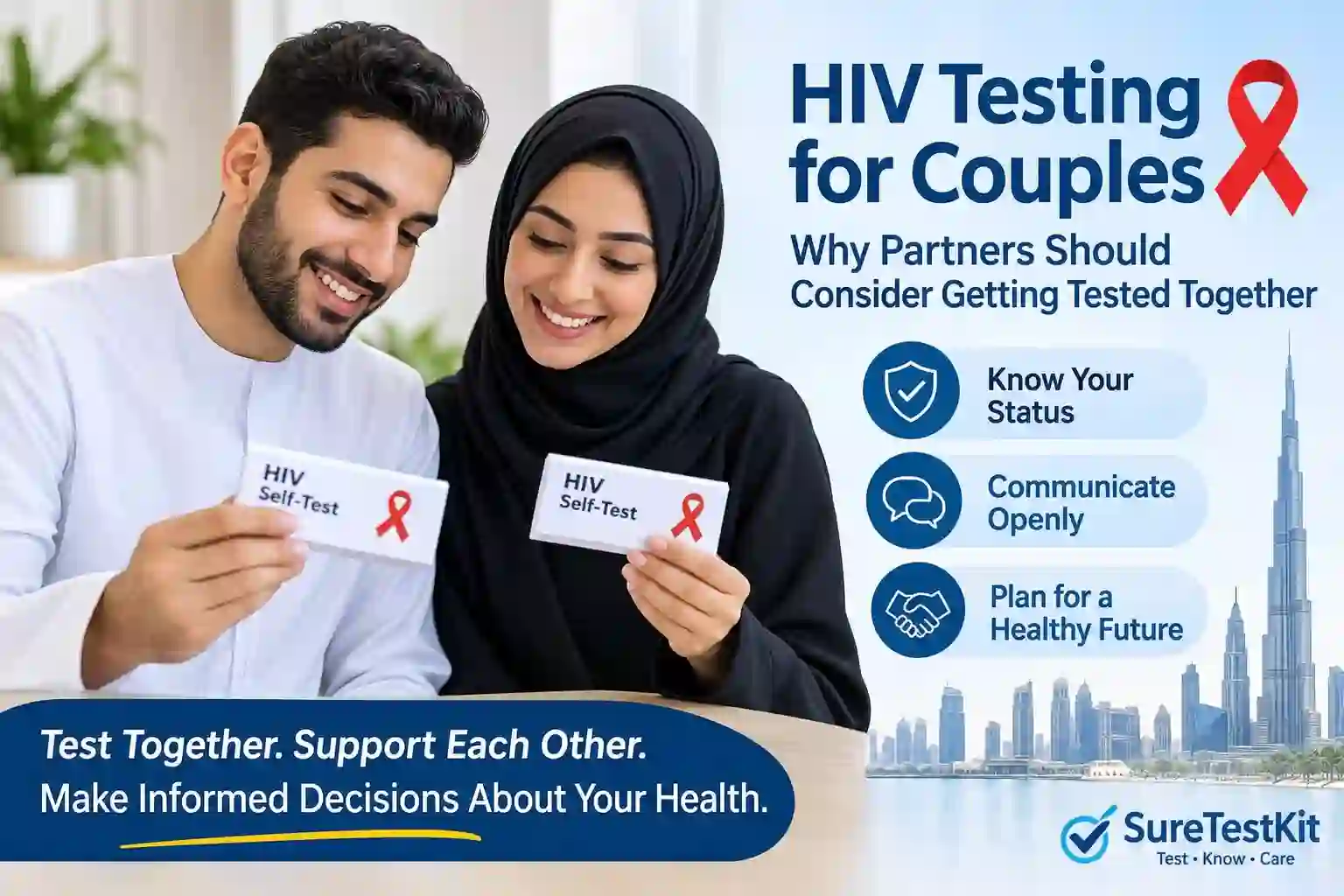
A Practical HIV Screening Guide for Couples in Dubai, Sharjah, Abu Dhabi and Across the UAE
Starting a new relationship, planning a future together or simply wanting to take better care of your health? HIV testing can be an important part of looking after yourself and your partner.
Many people assume that HIV testing is only necessary when someone has symptoms or knows they have experienced a possible exposure. In reality, HIV can be present without noticeable symptoms, and the only way to know a person's HIV status is through appropriate testing.
For couples, getting tested can create an opportunity to discuss sexual health, understand individual results and make informed decisions about prevention. Testing together is one option, but each partner should always be free to choose how and when to test.
This guide explains why couples may consider HIV screening, what to know before testing, how to understand results and where home testing may fit into a personal screening plan in the UAE.
1. Why Should Couples Consider HIV Testing?
HIV testing is not an indication of mistrust, infidelity or wrongdoing. It is a routine health decision that can help people understand their status.
The US Centers for Disease Control and Prevention (CDC) recommends that everyone aged 13–64 get tested for HIV at least once as part of routine healthcare, with more frequent testing for people with certain risk factors. It also advises people considering a new sexual relationship to discuss their status and consider testing together.
There are several reasons couples may find testing useful:
Knowing your own status: A test gives each person information about their individual HIV status.
Making informed decisions: Results can help partners discuss prevention and future healthcare choices.
Planning a family: People planning pregnancy can discuss HIV screening and appropriate medical care with a healthcare professional.
Reducing uncertainty: Testing can help replace assumptions with reliable information.
Encouraging open communication: A respectful conversation about sexual health can support a healthier relationship.
Importantly, one partner's result does not establish the other partner's status. Both people need their own appropriate test.
2. When Should Partners Get Tested?
There is no single testing schedule that is right for every couple. The timing depends on previous testing, possible exposures, individual risk factors and the type of test being used.
Couples may consider discussing HIV testing:
Before starting a new sexual relationship.
When either partner has never been tested.
When either person has had a possible HIV exposure since their last test.
When either partner has had other sexual partners since their previous screening.
When a healthcare professional recommends testing based on individual circumstances.
When planning pregnancy or discussing reproductive health.
People with ongoing risk factors may need regular testing rather than a one-time test. The CDC recommends at least annual testing for certain groups and notes that some sexually active people may benefit from testing every three to six months, depending on their circumstances.
A healthcare professional can help determine an appropriate schedule.
3. Can Couples Take an HIV Test Together at Home?
Yes. Depending on the specific test, partners may choose to use separate home HIV self-test kits in the same setting.
For example, two partners might decide to:
Read the instructions for their respective test kits.
Check that each kit is within its expiry date and that the packaging is intact.
Collect their own samples according to the manufacturer's instructions.
Perform each test separately and follow the stated timing.
Read and interpret each result using the kit's instructions.
Seek professional advice if either result is reactive, invalid or difficult to interpret.
A home self-test can offer a private way to screen, but it is important to understand its limitations. Not every HIV test uses the same sample type or detects infection at the same stage.
Never assume that one test kit can be shared between two people. Each person should use an individual test device and all supplied single-use materials as directed.
If either partner prefers to test privately or separately, that choice should be respected. Testing together is an option, not a requirement.
4. Understanding the HIV Test Window Period
One of the most important things couples should understand is the HIV window period.
The window period is the time between a possible HIV exposure and the point when a particular test can reliably detect infection. A test taken too early may produce a negative result even if infection has occurred.
According to the CDC, typical detection windows are:
| HIV test type | Typical detection window |
|---|---|
| Nucleic acid test (NAT) | 10–33 days |
| Laboratory antigen/antibody test using venous blood | 18–45 days |
| Rapid antigen/antibody test using finger-prick blood | 18–90 days |
| Antibody test | 23–90 days |
These ranges are general guidance, not a guarantee for every individual or product. Many HIV self-tests are antibody tests, but you should check the exact test type and instructions supplied with your kit.
If a person receives a negative result during the window period, they may need another test after the applicable window period.
If either partner has had a recent possible exposure, they should not rely on an early negative self-test to rule out HIV.
Important: If a possible significant HIV exposure occurred within the past 72 hours, seek urgent medical assessment for post-exposure prophylaxis (PEP). Do not wait for a home test result before seeking care.
5. What If One Partner Tests Reactive?
A reactive result on an HIV self-test does not by itself establish a confirmed HIV diagnosis.
It means that the screening test has detected a signal that requires follow-up. The person should contact a qualified healthcare provider or appropriate testing service for confirmatory testing and guidance.
If one partner receives a reactive result:
Stay calm and avoid jumping to conclusions.
Arrange professional follow-up testing promptly.
Follow the healthcare professional's advice about prevention while the result is being clarified.
Avoid blaming, pressuring or stigmatizing either partner.
Discuss next steps with appropriate medical support.
If HIV is confirmed, effective antiretroviral treatment (ART) can help people living with HIV maintain their health. With sustained viral suppression below 200 copies/mL, a person living with HIV does not sexually transmit HIV. This is known as U=U (Undetectable = Untransmittable).
A reactive screening result should therefore lead to medical follow-up, not assumptions about when or how infection may have occurred.
6. What If Both Partners Test Negative?
Two negative results can be reassuring when both tests have been performed at the appropriate time and interpreted correctly.
However, consider the following:
Were both tests taken after the relevant window period?
Has either person had a possible exposure since testing?
Is either partner using PrEP or has either recently taken PEP?
Does either person have ongoing risk factors that require repeat testing?
A negative result reflects the status detected by that person's test at that time. It does not guarantee that the person will remain HIV-negative after a future exposure.
For couples who want to reduce future risk, a healthcare professional can discuss prevention options such as condoms, PrEP where appropriate and regular screening.
7. Is Home HIV Testing a Good Option for Couples in the UAE?
Home HIV self-testing may be suitable for adults who want to screen in a familiar setting and are comfortable following the test instructions.
For couples in Dubai, Sharjah, Abu Dhabi and other UAE emirates, the main considerations should be the test's specifications, sample requirements, instructions and follow-up pathway.
Before choosing a kit, check:
Test type: Is it an antibody test or an antigen/antibody test?
Sample type: Does it use finger-prick blood, oral fluid or another sample?
Window period: When can the test detect infection after exposure?
Instructions: Are the steps and result interpretation clearly explained?
Expiry and packaging: Is the kit sealed, intact and within its expiry date?
Follow-up: Do you know where to seek professional testing if the result is reactive or uncertain?
Explore the available options on the SureTestKit HIV test kit page. You can also review the HIV 4th Generation Test Kit and HIV 1/2 Antibody Test Kit.
Always read the product-specific information before purchasing. Do not assume that every product has the same detection window or testing capability.
8. How to Talk to Your Partner About HIV Testing
Starting a conversation about HIV screening can feel uncomfortable, especially if neither person has discussed sexual health before.
Try approaching the subject as a shared health decision rather than an accusation.
You might say:
"I think we should both know our HIV status."
"Would you feel comfortable discussing sexual health and screening together?"
"I would like us to make informed decisions about our health."
"We can each choose the testing option that feels comfortable."
Remember that testing should always be voluntary. Neither partner should be threatened, pressured or forced to take a test or disclose a result.
If discussing testing together could create conflict or put someone at risk, individual testing and confidential professional support may be safer options.
9. HIV Testing Is Only One Part of Sexual Health
HIV screening is important, but it does not check for every sexually transmitted infection.
Depending on individual circumstances, couples may also want to discuss screening for:
Syphilis
Chlamydia
Gonorrhoea
Hepatitis B
Hepatitis C
Different infections require different tests, samples and screening schedules. A healthcare professional can help identify which tests are appropriate.
You can also explore the SureTestKit range of screening kits to review available options.
Final Thoughts: Make HIV Testing Part of a Healthy Relationship
HIV testing can help couples make informed decisions about their health and future. Whether partners choose to test together, separately or through a healthcare provider, the important points are informed consent, appropriate timing and accurate interpretation.
A negative result should be considered in relation to the test's window period and any subsequent exposures. A reactive self-test requires professional follow-up, while a recent possible exposure within 72 hours needs urgent medical assessment for PEP.
If you and your partner are considering HIV screening, learn about the available testing options and choose an approach that is medically appropriate and comfortable for both of you.
Your health is worth an honest conversation and an informed decision.
Medical note: This article provides general educational information and is not a substitute for individual medical advice, diagnosis or treatment. HIV self-tests are screening tools. Follow the specific product instructions and seek professional follow-up for reactive, invalid or uncertain results.
Frequently Asked Questions
1. Should couples get tested for HIV before starting a relationship?
Couples may consider testing before starting a sexual relationship so both partners understand their individual status. Testing should be voluntary and accompanied by an honest discussion about sexual health.
2. Can two people use one HIV test kit?
No. Each person should use a separate test device and their own single-use materials, following the manufacturer's instructions.
3. If my HIV test is negative, does that mean my partner is also negative?
No. Each person's result applies only to that individual. Both partners need their own appropriate tests.
4. Can couples use HIV self-test kits at home?
Depending on the product, adults may use individual HIV self-test kits at home. They must follow the supplied instructions and understand the window period and limitations of the test.
5. What happens if one partner gets a reactive HIV self-test result?
A reactive self-test requires follow-up testing through a qualified healthcare provider. It should not be treated as a confirmed diagnosis on its own.
6. How soon after exposure should couples get tested?
The appropriate timing depends on the test type. Antibody tests may have a window period of 23–90 days, while laboratory antigen/antibody tests using venous blood may detect infection within 18–45 days. Follow the test-specific guidance and seek clinical advice.
7. Does HIV testing protect couples from all STIs?
No. An HIV test only screens for HIV. Other infections, such as syphilis, chlamydia and gonorrhoea, require their own appropriate tests.
8. Where can I explore HIV self-test kits in the UAE?
You can review available options at SureTestKit. Check each product's specifications and instructions before choosing a test.
Disclaimer
This content is intended for informational purposes only and should not be considered a substitute for professional advice. Always consult with a qualified professional for specific concerns.